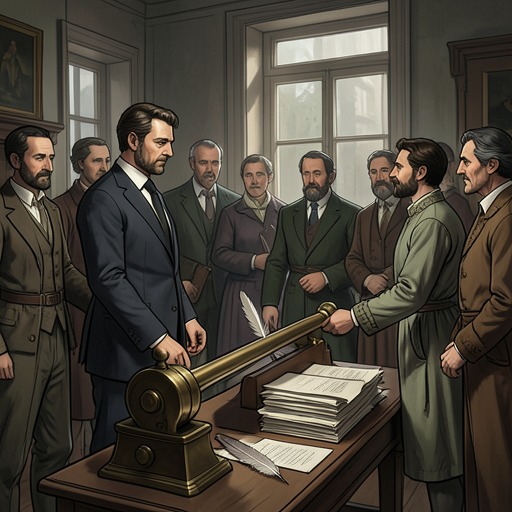
Articles of Confederation requisition system
Federalist PapersThe Articles of Confederation requisition system made the Union dependent on the states to supply the money and men required for common purposes. In the Federalist argument, this was not simply an imperfect administrative arrangement: it set up incentives for noncompliance, frustrated revenue and defense, and left national decisions subject to thirteen separate judgments. Its demonstrated failures became a central reason for proposing a federal government able to act directly on individuals and raise its own resources.
How the system worked—and why it failed
Under the Confederation, Congress could make requisitions for money and men, but fulfillment depended on the states. The system therefore asked state governments to convert national decisions into their own measures and contributions. The essayist argues that each state would judge a request through its immediate interests and conveniences, without possessing the national perspective needed to assess the common purpose. Even when Congress had settled on a policy, implementation could fluctuate with the separate, locally oriented decisions of the members.
The outcome, the argument maintains, was visible in the paralysis of the national government. The concurrence of thirteen sovereign wills was required for the complete execution of important measures. State delinquencies accumulated until they arrested the wheels of government; Congress scarcely retained the means to maintain even the forms of administration while the states considered a replacement for the existing system. The breakdown had grown gradually: unequal compliance first made some states bear more than others, then allowed those still contributing to treat their own default as a reasonable response to their neighbors’ example.
That sequence made the requisition system vulnerable to a feedback loop. States that complied could ask why they should carry a greater share than fellow members in the same political enterprise. As each yielded to immediate interest or convenience, it withdrew support in turn. The resulting decline was not attributed to a single abrupt refusal but to mutually reinforcing defaults that left the Union’s institutional structure increasingly frail.
Quotas, revenue, and unequal burdens
For financial contributions, the Confederation relied on quotas. The essayist treats this as a fundamental error both because it failed to secure adequate supplies and because no single measure could fairly determine the states’ relative ability to pay. Land values and population, proposed in turn as standards, did not track wealth reliably. Comparisons among the United Netherlands, Russia, Germany, and France illustrate the disparity between the size or population of a country and its actual wealth; comparisons among Virginia and North Carolina, Pennsylvania and Connecticut, or Maryland and New Jersey are offered to make the same point within the United States. Even within New York, the active wealth of King’s County could not be inferred from its land value or population relative to Montgomery County.
The argument attributes differences in wealth to an interlocking range of causes, including location, soil, climate, production, government, citizens’ capacities, knowledge, commerce, arts, and industry. Since these factors admit no common measure, a fixed quota rule could impose glaring inequality: some states’ citizens might be impoverished by public burdens that others scarcely felt. If such a system could be enforced, the burdened states would eventually have reason to resist an association that distributed obligations so unevenly. The defect was therefore presented as a threat not only to fiscal sufficiency but to the Union’s durability.
The proposed alternative was to authorize the national government to raise revenue in its own way. Duties on consumption, including imposts and excises, would draw contributions through purchases rather than assign each state a quota based on an unreliable comparison of wealth. The essayist likens such taxes to a fluid that finds its level: individuals could in some measure adjust their contribution to their means, with the rich able to spend extravagantly and the poor to live frugally. Unequal effects among states from duties on particular goods might be offset by differences in duties on other goods. In this account, consumption taxes would not eliminate every inequality, but their operation would be less uniform, less severe, and less visibly unjust than quotas.
The same reasoning connects revenue collection to commerce. The essays argue that direct taxation had repeatedly failed to produce substantial sums: multiplying tax laws and trying new collection methods had left state treasuries empty, in a country where money was scarce and trade weak. Import duties were expected to remain a principal source of revenue. A general Union, by promoting commerce and simplifying the collection of duties, could make a given rate more productive and permit an increase without injuring trade. Separate jurisdictions, by contrast, risked illicit exchange across rivers, bays, and familiar routes; mutual jealousy might push states toward low duties rather than effective collection.
Consumption duties also had, in this argument, a built-in restraint. If rates rose too high, people would reduce consumption or evade collection, so the treasury might receive less than it would under moderate duties. The tax would thus limit itself through its effect on the activity from which revenue was drawn. This feature contrasted with quotas, whose unequal burdens could persist even when they failed to produce adequate public funds.
Military requisitions and the cost of delay
The system’s military counterpart required states to provide quotas of men. During the recent war, competition among states created what the essay calls an auction for recruits. States bid against one another with increasingly large bounties to meet their assigned numbers. Those willing to serve had reason to postpone enlistment in hope of a better offer, and the incentives discouraged long engagements.
The consequences reached beyond expense. In critical moments, levies were slow and insufficient; enlistments were short and exceptionally costly; and continual changes in the composition of the forces weakened discipline. Public safety was repeatedly exposed to the danger of an army disbanding. The system also led to oppressive measures for raising men, which, the essay argues, the people endured only because of their enthusiasm for liberty.
The allocation of military burdens was no fairer than the allocation of money. States near the seat of war, moved by self-preservation, sometimes exerted themselves beyond their abilities, while states farther from danger were generally less diligent. Unlike monetary shortfalls, which might at least be entered as debts to be settled later, missing troop contributions could not be accounted for in the same way. The essays question whether even the most delinquent states could ever compensate for their financial failures, much less repair the unrecorded shortfalls in manpower.
The conclusion is categorical: whether applied to money or to men, quotas and requisitions made the Union weak and distributed burdens unequally and unjustly. Their shared defect was dependence on separate state decisions for resources that the national government was expected to deploy for common purposes.
The constitutional alternative and its limits
The remedy advanced in the essays was a change in the system’s first principles. Instead of legislating upon states in their collective capacities, the federal government should extend its laws to individual citizens. It should have authority to levy troops, build and equip fleets, and raise the revenue required for military forces through the ordinary methods used by other governments. The case for that authority also included the national civil expenses, payment of existing and future national debts, and other disbursements from the treasury. Regular and adequate revenue is described as indispensable: without it, people might face continual plunder as a substitute for orderly provision, or government might decay and perish.
This argument did not claim that every function should be absorbed by the Union. If the country required a compound rather than a simple government, the powers of its different departments had to be distinguished, with each given sufficient authority over the subjects assigned to it. The national government would need powers concerning common defense, fleets, armies, revenues, and commerce; other matters could remain within state jurisdiction. The intended change was therefore from a federation dependent on requests to states to a government capable of executing its assigned responsibilities directly.
The Federalist defense also treats federal power as bounded by its constitutional grants. The Necessary and Proper Clause would authorize laws for carrying enumerated federal powers into effect, while the Supremacy Clause would make supreme only those federal laws made pursuant to the Constitution. The essayist argues that these clauses state consequences already implied by creating a government with specified powers; they do not convert every federal act into valid law. A law concerning a state’s inheritance rules, or an attempt to repeal a state land tax under the pretext of protecting federal revenue, would exceed federal authority and intrude on state jurisdiction. Citizens, as the government’s constituents, would ultimately judge and address a tyrannical overreach.
The proposed arrangement thus answered the requisition system’s central weakness without treating national supremacy as unlimited. It sought reliable revenue and defense through direct federal authority, but located that authority within a defined constitutional division of powers. Its institutional significance lies in the contrast between two modes of government: one that depends on members to fulfill requests, and one that can act on citizens while remaining subject to the constitutional limits that authorize it.